
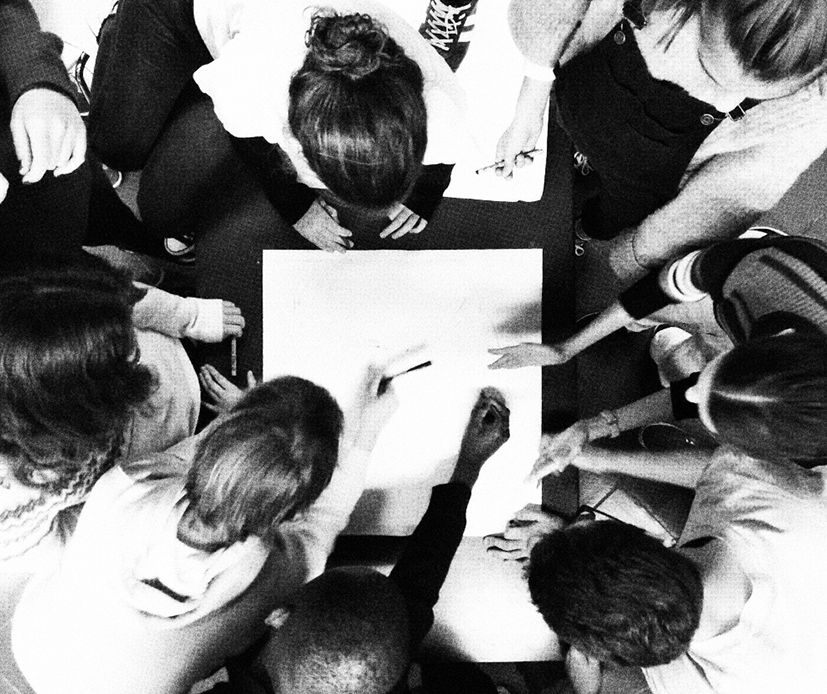
Shared learning: Collective Actions and Drawing in Architectural Education
Abstract
As architectural challenges become socially and ecologically complex, education must foster collective thinking, presence, and action. This research argues that freehand drawing remains a primordial mode of communication, enabling students to externalize thought, engage with place and community, and reflect collectively. While digital transformations reshape architectural representation, the architect’s role as facilitator requires renewed forms of direct and critical communication. The methodology combines theoretical insights from participatory and experiential pedagogies with an emphasis on being present in complex real-world contexts—from personal space to urban environments—where observation, movement, and embodied engagement mediate understanding. Learning dynamics integrate collaborative exercises, feedback, and shared representation, fostering negotiation, improvisation, and co-creation. These principles are applied through teaching experiments at the Barcelona School of Architecture: first-year Drawing courses develop technical and narrative skills while fostering group dialogue; the Urban Notes elective emphasizes ethnography, mapping, and collective interpretation of neighborhoods; and the Ciudad & Infancias workshops engage students, children, and communities in tactical urban interventions. Findings show that drawing operates as a cognitive tool, a medium of dialogue, and a platform for collective reflection, linking imagination, perception, place, and social action. These hybrid approaches—combining individual skill development, collaboration, and real-world engagement—may foster empathetic, socially responsive architects.
DOI: https://doi.org/10.20365/disegnarecon.36.2026.11
Keywords
Full Text:
PDFRefbacks
- There are currently no refbacks.
Copyright (c) 2026 Bruno Seve, Queralt Garriga, Sebastian Harris
DISEGNARECON
ISSN 1828 5961
Registration at L'Aquila Law Court no 3/15 on 29th June, 2015.
Indexed in SCOPUS. Diamond Open Access. All papers are subjected to double blind peer review process by qualified reviewers.
Journal founded by Roberto Mingucci