
Shortening the Distance between Representation and Reality: Augmented Reality and the Transformation of Architectural Education
Abstract
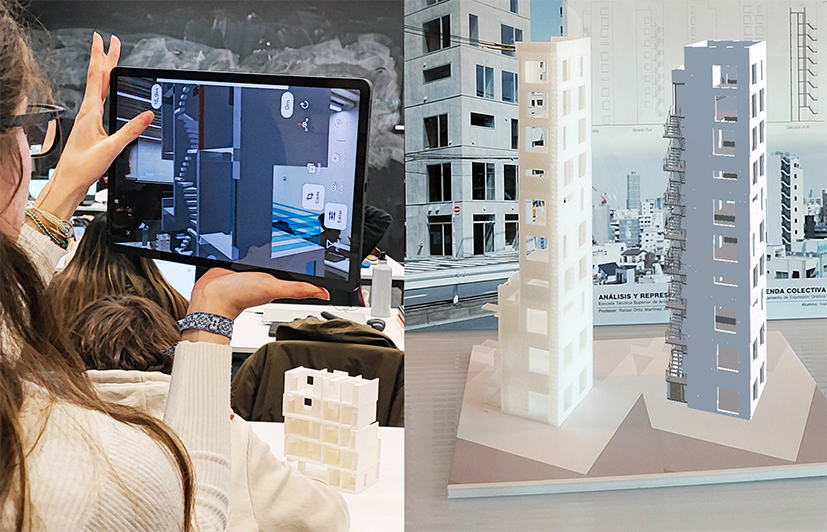
The contemporary transformation of graphical sciences is inseparable from the progressive integration of digital, immersive, and intelligent systems into processes of representation, interpretation, and design. Within this shift, architectural education emerges as a field of experimentation, where the disciplinary legacy of drawing encounters new cognitive and technological conditions. This paper reflects on the evolving role of graphical sciences in architectural education, interpreting augmented reality (AR) as a spatial, cognitive, and interactive environment capable of redefining how students observe, understand, and construct architectural space.
The contribution develops along two complementary lines. First, it frames the current transformation of graphical sciences as a transition from static representation toward immersive, context-aware, and experience-based modes of knowledge production. Second, the paper discusses the educational potential of augmented reality through the lens of architectural pedagogy, focusing on its capacity to strengthen spatial understanding, reduce the interpretative gap between two-dimensional abstraction and three-dimensional experience, and foster more active and situated learning processes.
The reflection is supported by a critical review of recent literature on AR, XR, immersion and spatial cognition, as well as by teaching experiences based on student work developed through augmented reality environments. The paper argues that the future of graphical sciences in education lies in the construction of new pedagogical frameworks able to integrate representation, interaction and critical awareness.
DOI: https://doi.org/10.20365/disegnarecon.36.2026.8
Keywords
Full Text:
PDFRefbacks
- There are currently no refbacks.
Copyright (c) 2026 Rafael Ortiz Martinez de Carnero
DISEGNARECON
ISSN 1828 5961
Registration at L'Aquila Law Court no 3/15 on 29th June, 2015.
Indexed in SCOPUS. Diamond Open Access. All papers are subjected to double blind peer review process by qualified reviewers.
Journal founded by Roberto Mingucci