
Facing the complexity. Digital tools in transformation toward heritage cognitive-interpretative approaches through graphical representation
Abstract
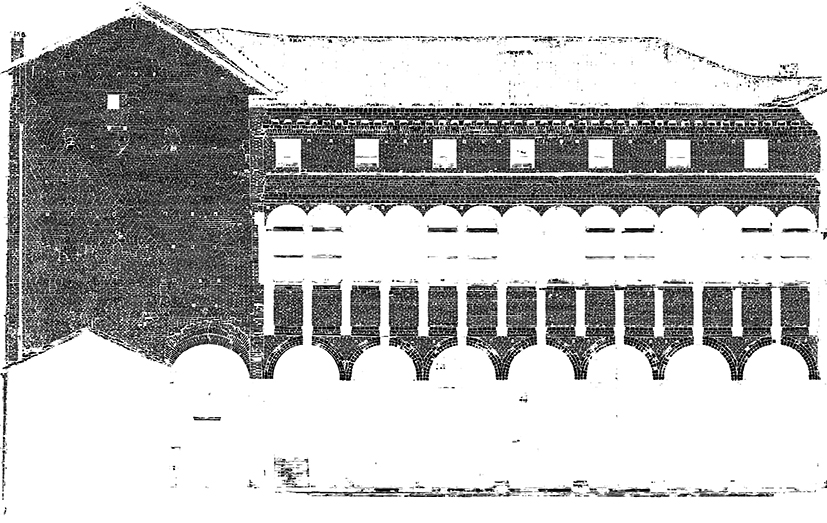
The rapid evolution of digital surveying technologies and AI-based tools is reshaping discretisation processes in architectural representation, introducing new modes of data acquisition, analysis, and interpretation. In this context, however, the construction of knowledge remains inseparable from a methodological framework grounded in hierarchisation and interpretation that are intrinsic to surveying and representation. Whereas in the analogue tradition these operations were embedded within the very act of drawing as a discrete practice, in digital processes, they become fragmented and therefore require explicit critical and epistemological clarification. Within this framework, automatic segmentation emerges as an effective tool for the local classification of surfaces; however, it reveals significant limitations in reconstructing the geometric, spatial, and constructive relationships that shape architectural language. This contribution addresses these critical issues through the application of deep learning models for the semantic segmentation of masonry textures, focusing on the case study of Palazzo Costabili in Ferrara. The model, trained on datasets generated through supervised annotation processes, aims to evaluate its capacity to recognise and organise recurring morphological characteristics in masonry structures. One the main research questions is related to the chance to reconstruct, through segmentation, complex configurations as organised systems, leveraging on interpretative choices embedded in the annotation process, analysing automatic recognition and classifications towards a critically meaningful structure of graphic representation and knowledge drawing.
DOI: https://doi.org/10.20365/disegnarecon.36.2026.5
Keywords
Full Text:
PDFRefbacks
- There are currently no refbacks.
Copyright (c) 2026 Federica Maietti
DISEGNARECON
ISSN 1828 5961
Registration at L'Aquila Law Court no 3/15 on 29th June, 2015.
Indexed in SCOPUS. Diamond Open Access. All papers are subjected to double blind peer review process by qualified reviewers.
Journal founded by Roberto Mingucci