
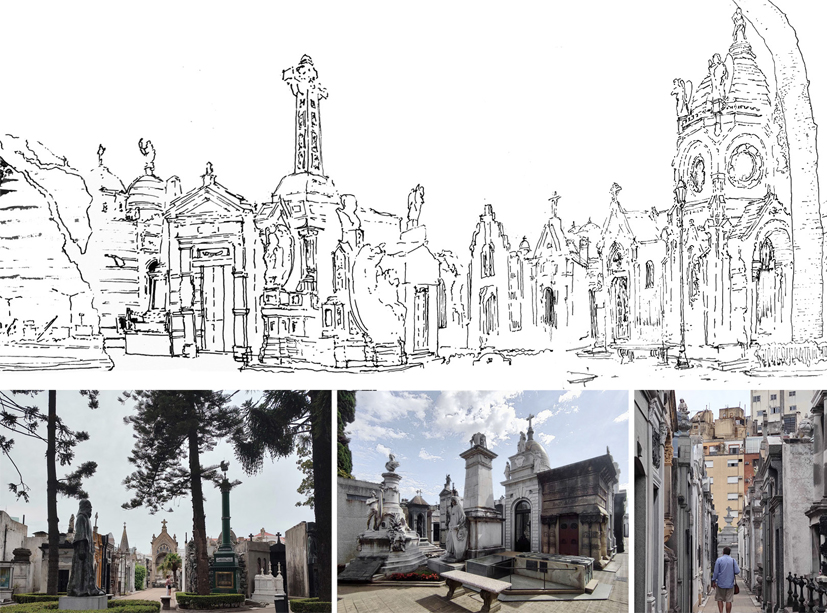
Recoleta: the dual threshold between the city of stone, the represented city, and the digital city
Abstract
The cemetery, as a site of individual and collective memory sedimentation, represents a cultural construction that transcends its burial function to become a testimony to the past and to the way society relates to death.
Among monumental cemeteries, the Recoleta Cemetery in Buenos Aires stands as an emblematic case. Its architectural layout and the stylistic variety of its tombs not only reflect the historical and cultural evolution of the city but also transform the cemetery itself into a true city of memory. Here, the boundary between urban and funerary space dissolves into a continuous dialogue between the monumentality of the tombs and the vibrancy of a ‘social’ fabric that continues to inhabit them through remembrance.
This study aims to explore Recoleta as a narrative landscape, where memory is constructed through representation, from the materiality of architecture to new forms of digitization. By analyzing the cemetery as a microcosm, monumentality as an expression of collective memory, and the relationship between identity and migration, the paper reflects on how visual and digital representation can become an act of preservation and reinterpretation of funerary heritage.
DOI: https://doi.org/10.20365/disegnarecon.35.2025.4
Keywords
Full Text:
PDFRefbacks
- There are currently no refbacks.
Copyright (c) 2025 Giulia Porcheddu, Salvatore Barba, Sandro Parrinello
DISEGNARECON
ISSN 1828 5961
Registration at L'Aquila Law Court no 3/15 on 29th June, 2015.
Indexed in SCOPUS. Diamond Open Access. All papers are subjected to double blind peer review process by qualified reviewers.
Journal founded by Roberto Mingucci